AI-Driven Lifecycle Costing for Acoustic Systems and Sustainable Finishes
From Capital Cost to Whole-Life Value
Lifecycle costing has become central to sustainable building decision-making, particularly for acoustic systems and interior finishes that influence long-term operational performance and occupant comfort. Traditional costing models often struggle to capture maintenance cycles, replacement intervals, and performance degradation over time. AI-driven lifecycle costing introduces data-led methods that evaluate total cost of ownership alongside environmental and acoustic performance, enabling more informed specification strategies.

Foundations of AI-Driven Lifecycle Costing
Data Inputs and Predictive Modelling
AI-based lifecycle costing models integrate diverse datasets, including material properties, installation costs, maintenance schedules, and historical performance records. Machine learning algorithms identify patterns across comparable projects, allowing predictions of long-term cost trajectories for acoustic panels, ceiling systems, and sustainable finishes². This approach reduces reliance on static assumptions and improves forecast accuracy over a building’s lifespan.
Integration With Lifecycle Assessment Frameworks
Lifecycle costing increasingly aligns with lifecycle assessment (LCA) methodologies, linking financial and environmental performance. AI tools can process LCA datasets alongside cost information, correlating embodied carbon, durability, and replacement frequency with long-term expenditure³. This integration supports balanced decisions where acoustic performance, sustainability, and cost efficiency are evaluated simultaneously.
Scenario Analysis and Design Iteration
One of AI’s key advantages is rapid scenario testing. Designers can compare alternative acoustic systems or finish specifications under different maintenance or usage assumptions, observing cost impacts in real time. This capability supports early-stage design optimisation, where small specification changes can deliver significant lifecycle savings.
Lifecycle Costing in Acoustic and Interior Systems
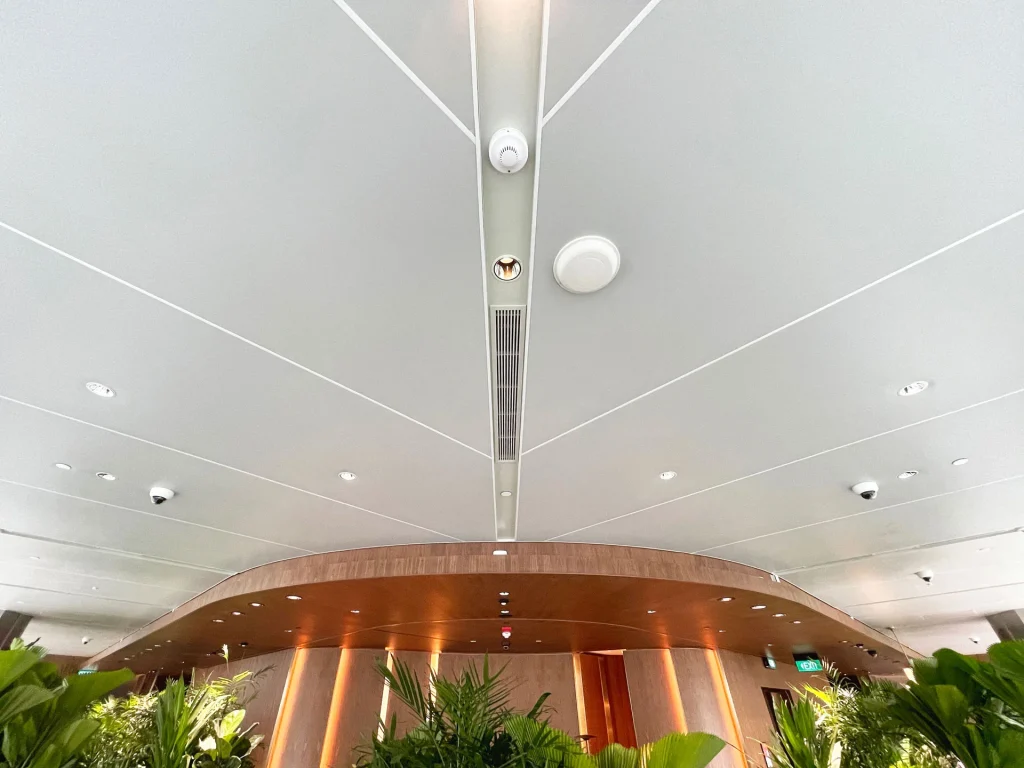
Acoustic systems and interior finishes often involve recurring maintenance, refurbishment, or replacement, making them well suited to lifecycle-based evaluation. AI-driven costing frameworks help quantify how material durability, cleanability, and performance stability influence long-term value, particularly in high-use environments such as offices, education, and healthcare facilities.
Decision-Making Implications for Specification
Procurement Strategies and Long-Term Value
AI-informed lifecycle costing encourages procurement decisions based on total value rather than lowest upfront price. Acoustic systems with higher initial costs may demonstrate lower lifetime expenditure due to reduced maintenance or extended service life. This shift supports more resilient specification strategies aligned with sustainability and asset management goals.
Risk Reduction and Budget Certainty
By learning from large datasets, AI models improve confidence in long-term cost projections. This reduces financial risk associated with unexpected maintenance or premature replacement of finishes. For building owners, improved predictability supports capital planning and aligns acoustic performance objectives with budget certainty.
Digital Workflows and Performance Feedback
BIM Integration and Cost Transparency
AI-driven lifecycle costing tools increasingly integrate with Building Information Modelling (BIM) platforms. This allows cost data to be linked directly to acoustic elements and finishes within the digital model, improving transparency and coordination across disciplines. Updates to design geometry or material selection automatically adjust lifecycle cost projections.
Post-Occupancy Data and Model Refinement
Operational data collected after occupancy provides feedback that refines AI models over time. Measured acoustic performance, maintenance records, and user behaviour inform future predictions, improving accuracy across subsequent projects. This feedback loop supports continuous improvement in both cost modelling and specification quality.
Optimising Long-Term Performance Through AI
AI-driven lifecycle costing represents a significant evolution in how acoustic systems and sustainable finishes are evaluated. By combining predictive analytics with lifecycle assessment principles, these tools enable more nuanced understanding of long-term financial and environmental performance. For specifiers and building owners, this approach shifts focus from short-term savings to durable value, supporting acoustic comfort, sustainability, and cost certainty over the full building lifecycle. As digital workflows mature and datasets expand, AI-based lifecycle costing is likely to become a standard component of responsible, performance-led specification.
References
- International Organization for Standardization. (2017). ISO 15686-5: Buildings and constructed assets — Service life planning — Part 5: Life-cycle costing. ISO.
- International Organization for Standardization. (2006). ISO 14040: Environmental management — Life cycle assessment — Principles and framework. ISO.
- National Institute of Standards and Technology. (2023). Artificial Intelligence Risk Management Framework (AI RMF 1.0). NIST.
- Pomponi, F., & Moncaster, A. (2017). Circular economy for the built environment: A research framework. Journal of Cleaner Production, 143, 710–718.
- Eastman, C., Teicholz, P., Sacks, R., & Liston, K. (2018). BIM Handbook: A Guide to Building Information Modeling for Owners, Designers, Engineers, Contractors, and Facility Managers. Wiley.
Share